

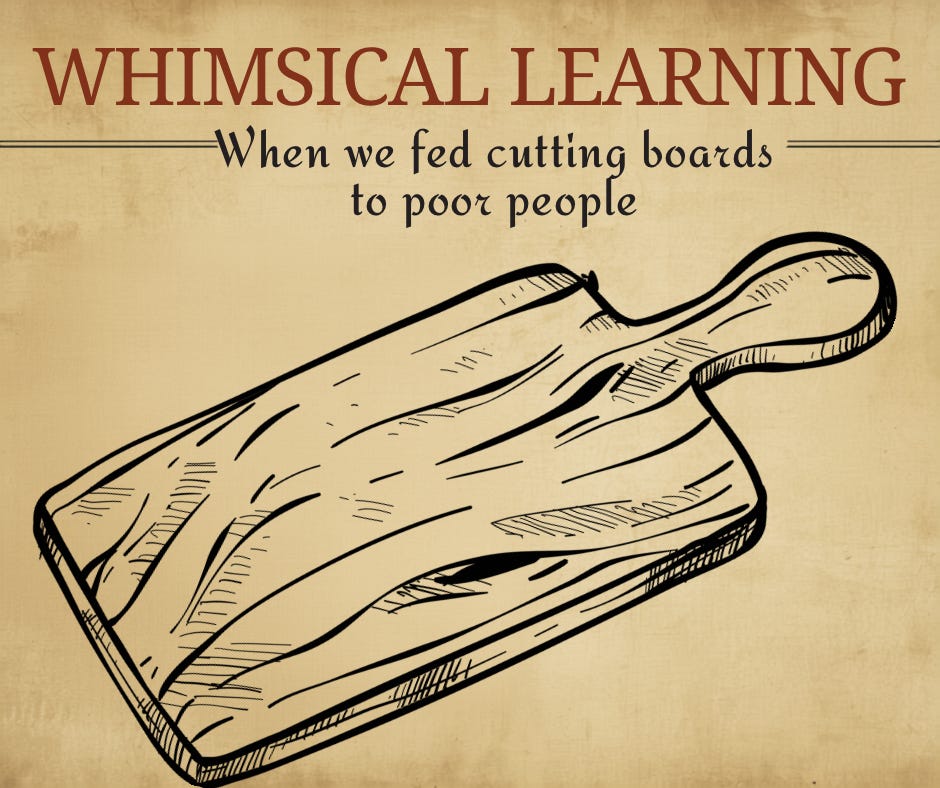
Today’s whimsical learning, typed from my phone while my wife plays Town to City, is about a recent pet fascination of mine: CUTTING BOARDS.
Now look, don’t cut from this post just because you’re board. *snicker*
No doubt you own a few of these things but holy moly you might be fascinated to learn there’s a lot going on here. Like some of them will fuck your knives up, some doubled as a human rights violations, and some of them fill your body with tiny shards of material and today I’m gonna be telling you about which is which!
Believe it or not the history of the cutting boards basically goes like this historically: stone slabs or tree bark for cutting, followed by mother fucking bread, followed by splintered wood, followed by plastic.
Let’s skip the oldest stuff and go to my favorite piece of cutting board history and the direct grandpa to today’s charcuterie boards: the trencher.
The trencher was a large, flat piece of bread that had been allowed to go stale. You would then use it either as a personal plate or like a communal cutting board. The juices from all of the meat and stuff would soak into the bread which would then be served to the poor or the dogs.
Not coincidentally trenchers were also used as personal plates. So… your plate and your cutting board share a common ancestor. Darwin would be proud.
Not fucking kidding. Because these were communal and folks were slicing meats and whatnot on it with their own personal knives it’s also not unlikely these helped to spread lots of illnesses to the poor since folks saliva, molds and spoiled foods were on them.
Ain’t that just fucked up?
Anyway the trencher later evolved to be made of wood because who wants to share with poor people, right? Keep it classy, France.
And that led to the use of sycamore butcher’s blocks which were weirdly prone to splitting but, alas.
Then we get to good old fashioned 1880s USA where some folks were like “man maybe we should be cutting on things that turn to splinters in our food” and they got a patent on a new kind of butcher’s block that used wood with the grain pointing upward in tiny blocks that were glued together. Because these grain was pointed upward instead of splitting it the knives would go into the fibers that would then compress back together after the knife was removed.
Which was honestly a great idea. Props. But the. We had to fuck it up in the 20th century with plastic because I guess it was cheap but they wanted you to think it was safer because the board was easy to wash and wouldn’t hold onto all those juices.
Little did we know every time you used the thing it was shaving tiny bits of plastic into your food. Also it turned out that they weren’t even better for cleanliness. Dangerous bacteria were drawn into the wood fibers and wouldn’t multiply there so… this was just another instance of the USDA talking out of its ass.
And then instead of going back to wooden blocks like sane people we decided to go with marble, glass, bamboo, teak, and tons of other things that are varying degrees of porous and will absolutely destroy your knives’ edges.
And now, finally, we’re returning to some common sense and lots of really great affordable wooden cutting boards are making it back into our homes.
Truly sometimes it ain’t worth fucking with a good thing. Also follow Joshua Weissman on YouTube his rant is what sent me down this rabbit hole weeks ago
Also, used chopsticks!